


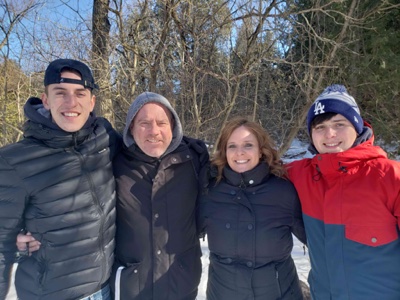
New half-day workshops offer an opportunity to connect
“As a parent or caregiver, I don’t think you ever forget the trauma,” says Nadine Vermeulen, recalling her youngest son Andrew’s hemorrhagic stroke at the age of ten.
Andrew was rushed to Sick Kids’ Hospital in Toronto where he underwent emergency brain surgery. Doctors weren’t sure he’d survive. “I think that’s the most stress that any parent can go through,” Nadine says.
That was four and a half years ago.
Andrew spent seventeen days at Sick Kids’ followed by two and a half months at Holland Bloorview Kids Rehabilitation Hospital.
“I had to ask the doctors probably a hundred times what happened to Andrew, because I just couldn’t understand how he could be playing one minute and be rushed to Sick Kids’ for emergency brain surgery the next.”
Looking back on her experience, Nadine realizes that it would have helped her a lot to talk to another parent who had gone through a similar experience. “I could talk to my mom, I could talk to my sisters, I could talk to my friends, but it’s not the same understanding. Until you’ve been through it…”
Since Andrew had his injury, Nadine has supported two other parents whose kids had strokes. She met them through mutual friends on Facebook. “I felt like… well, they both told me… that meeting me kind of helped them through the different stages.”
Nadine is now part of a group of moms helping to co-create a caregiver education workshop with Holland Bloorview and the Ontario Brain Injury Association (OBIA). The workshop is designed for parents of children with acquired brain injuries. “We all have different experiences,” Nadine says of the women in the workshop planning group. “But for all of us, one day our kids were fine and the next day they weren’t.”
OBIA is offering this workshop across Ontario along with a similar one for families of adults with acquired brain injuries. About forty workshops will be offered in total. Five of them will be for parents of children with brain injuries. They’re completely free but require registration online.
Both half-day workshops are highly interactive. Sessions are limited to a small number of participants to allow for greater discussion and interaction. Staff from local brain injury associations and other service providers will be there to meet caregivers and make connections. “The workshops are not intended as a one and done,” says Nancy LaJoie, OBIA’s Caregiver Educational Specialist.
“I honestly wish that this would have been around when we were going through this,” Nadine says. “It doesn’t just happen to your child; it happens to everyone in your family. Your life is flipped upside down and then you kind of have to pick up the pieces, and you have this new normal.”
Andrew has made an amazing recovery. According to his mom, he’s now your average 15-year-old kid. He’s an 80-average student. He doesn’t appear to have any long-term cognitive issues, although he’s probably a little more cautious than most kids.
Nadine hastens to add that the workshops are for all caregivers, regardless of the severity of their family member’s brain injury or their level of recovery.
Nadine’s participation in the workshop planning group is her way of giving back, but it’s also had added benefits for her. “As much as we’re getting together to put this workshop together for other caregivers,” she says, “we’re all learning from each other, too.” She’s picked up new coping strategies from other moms in the group.
It just goes to show that learning continues no matter how far along you are in your family caregiving journey.
Related articles:
- Caregiving is tough for professionals too
- Managing the toll of caregiver trauma
- Failure to Launch group supports parents with adult children at home
- Children with special needs who age out of the system